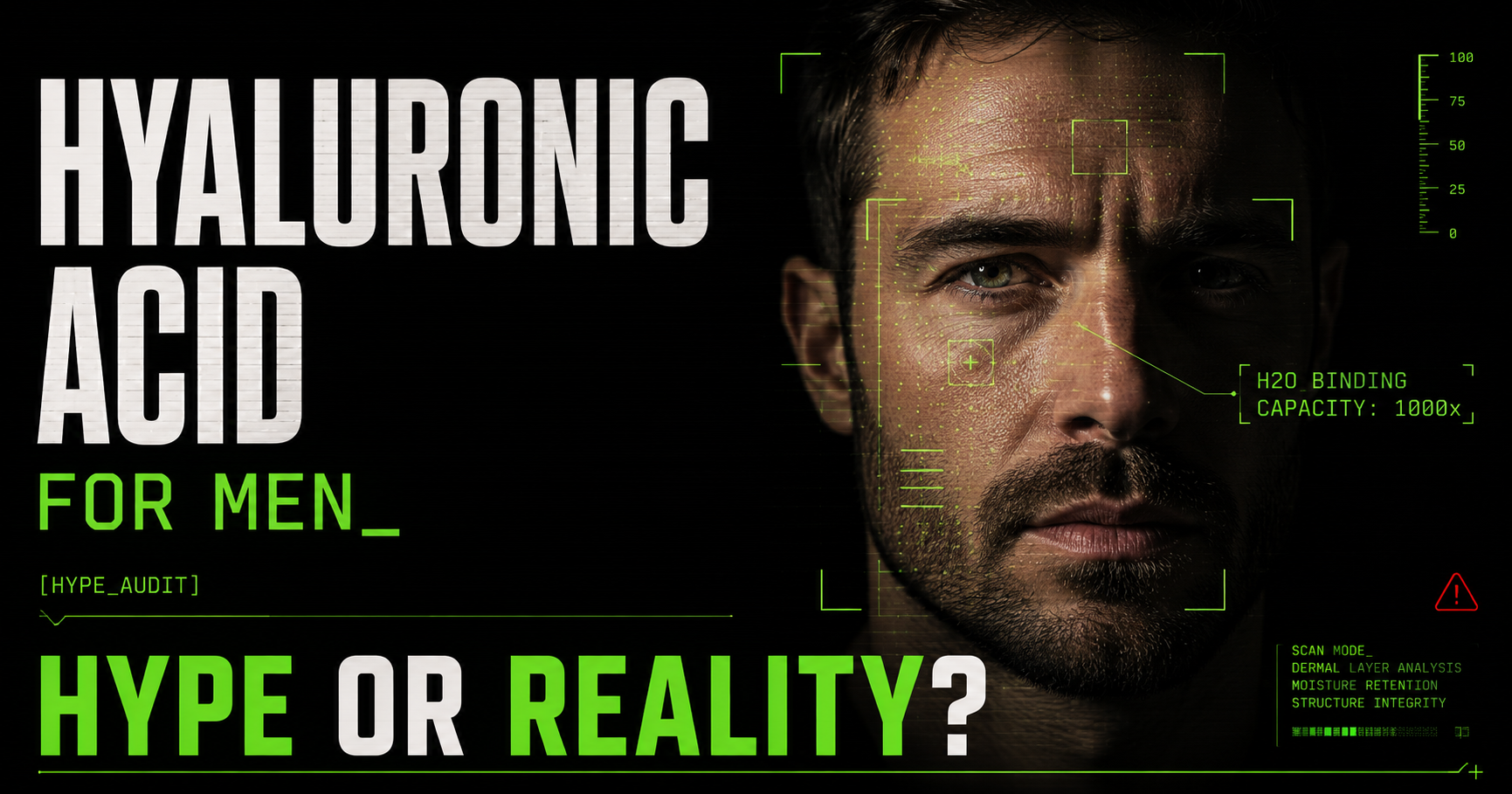
Hyaluronic acid (HA) is the most hyped skincare ingredient of the last 5 years. Every brand puts it in everything. Every TikTok influencer swears by it. Every man with skincare-curious friends has heard "you need a hyaluronic acid serum."
Here's the honest answer: it's useful for some men, pointless for others, and most product marketing around it is exaggerated.
This guide cuts through the hype and tells you whether HA is worth your time, money, and one more bottle on your shelf.
What Is Hyaluronic Acid?
Hyaluronic acid is a sugar molecule that naturally exists in your skin, joints, and connective tissue. Its main function is to bind water — a single HA molecule can hold up to 1,000 times its weight in moisture[1].
In skincare, HA is used topically as a humectant: it draws water into the upper layers of your skin, plumping it temporarily and making it look more hydrated[2].
It's not an active ingredient in the way retinol or BHA are. It doesn't change your skin's structure, fix acne, or fade dark spots. It hydrates. That's the entire story.
What Does Hyaluronic Acid Actually Do?
Hydrates the surface of your skin
This is the only thing HA does. It pulls water into the outer skin layer (stratum corneum), making skin look temporarily plumper, softer, and slightly more glowing. The effect lasts as long as the product is on your skin and your environment isn't too dry. Apply it morning, the hydration boost lasts most of the day. Stop using it, the effect goes away within 24-48 hours.
Temporarily reduces fine lines
Because it plumps the skin surface, very fine lines (especially around the eyes) look softer. This is temporary — same idea as how a dry sponge has cracks until you wet it. HA doesn't actually treat wrinkles; it just makes them less visible while applied.
Calms tight or dehydrated skin
If your skin feels tight, looks dull, or flakes during winter, HA helps. It addresses the symptom (dehydration) without trying to do anything else.
What it does NOT do
- Doesn't reduce oil production
- Doesn't unclog pores
- Doesn't fix acne
- Doesn't fade dark spots
- Doesn't build collagen long-term (despite marketing claims)
- Doesn't replace moisturizer (it pulls water in but doesn't seal it)
If you understand that HA is purely a hydration tool, you'll use it correctly. If you expect it to be a transformation product, you'll be disappointed.
Is Hyaluronic Acid Good for Men Specifically?
It depends on your skin type. This is where most generic advice breaks down.
Useful for
Mostly pointless for
- Men with oily, balanced, or acne-prone skin
- Young men under 30 with healthy hydration
- Men whose moisturizer already does the job
For most men with oily skin (which is the majority of male skin types), a good moisturizer with built-in hydration is enough. Adding a separate HA serum is usually redundant.
There's a specific exception: if you're using strong actives like prescription retinol or daily BHA, adding HA can help offset the dryness those cause. In that case, it's worth it.
The honest question most men should ask first: do you need a separate HA serum at all, or is the humectant in your moisturizer already doing the job? Here's HA against glycerin — the humectant already in most moisturizers:
| Hyaluronic Acid | Glycerin | |
|---|---|---|
| Type | Humectant | Humectant |
| Typical cost | Higher — sold as standalone serums | Cheap — pennies per use |
| Where you already have it | Usually a separate purchase | Already in most quality moisturizers |
| Hydration result | Effective | Equally effective, often more so |
| Need a separate product? | Only if skin still feels tight | Usually no — check your moisturizer label |
If your moisturizer already lists glycerin high in the ingredients, a separate HA serum is often redundant. Check the label before you spend.
How Do You Use Hyaluronic Acid?
What concentration to use
HA isn't measured by percentage the way actives are. Instead, look at:
- Multi-molecular-weight HA: Best formulation. Combines small molecules (penetrate deeper) with large ones (surface hydration). Most quality serums use this.
- Single-weight HA: Less effective. Cheap products often use only large-molecule HA which sits on top of the skin.
Look for serums that mention "low molecular weight," "high molecular weight," or "multi-weight HA" on the label.
When to apply it
CRITICAL_DETAIL
Apply HA to damp skin, then immediately seal with moisturizer.
HA is a humectant — it pulls water in. If your skin is dry and the air around you is dry, HA can actually pull water out of your skin instead of into it (making things worse).
Correct sequence:
-
01
Cleanse face
-
02
While skin is still slightly damp, apply HA serum
-
03
Within 60 seconds, apply moisturizer on top
This locks in the water HA is binding.
How often
Daily, morning or night. Both works.
Can you combine it with other actives?
Yes. HA plays well with everything:
- Retinol: HA actually helps reduce retinol dryness
- BHA / niacinamide: Layer HA after them
- Vitamin C: Apply HA after vitamin C
- Sunscreen: HA goes under SPF in the morning
It's one of the most "stackable" ingredients in skincare.
How Long Until You See Results?
HA results are immediate, not cumulative.
| Timeframe | What You'll Notice |
|---|---|
| Same day | Skin feels softer, looks slightly plumper |
| Week 1 | Improved comfort if your skin was tight or dry |
| Week 4 | If your barrier was compromised, ongoing improvement |
| Month 3+ | Stable hydrated state — no further "results" beyond this |
Unlike retinol or BHA, HA isn't building toward a transformation. You see the effect on day one, and it stays as long as you use it.
What Hyaluronic Acid Should You Buy?
Budget: The Ordinary Hyaluronic Acid 2% + B5 — $9
Solid formulation with multi-molecular-weight HA. Slightly sticky if you over-apply. Use 2-3 drops max.
Mid-range: CeraVe Hydrating Hyaluronic Acid Serum — $19
Combines HA with ceramides. Lightweight, non-sticky, good for oily-but-dehydrated skin. Best all-around pick for men.
Premium: Skinceuticals Hyaluronic Acid Intensifier — $108
Higher concentration with peptides. Genuinely better formulation, but the price-to-benefit ratio is poor unless skincare is a serious priority.
Skip: "Men's" branded HA serums
Same ingredient as the $9 version, marketed with imagery. You're paying for the bottle.
Common Mistakes
- Applying to dry skin. The most common mistake. HA pulls water from the nearest source — if your skin is dry and the air is dry, that source is your own skin. Always apply to damp skin.
- Not sealing with moisturizer. HA without a moisturizer on top can actually leave skin drier than before. Always layer.
- Expecting it to do more than hydrate. HA is a hydration tool. If you expected acne improvement, oil control, or anti-aging — you bought the wrong product.
- Buying expensive HA serums. The active ingredient is the same across price points. The Ordinary at $9 is as effective as $80 versions for most users.
- Using HA when you don't need it. If your moisturizer already keeps your skin hydrated, an additional HA serum is redundant. Save the money and the shelf space.
The Problem With Generic Skincare Advice
Hyaluronic acid is recommended to every man by every influencer because it's safe — it won't break anyone out, it won't irritate, it's a low-risk recommendation. That doesn't mean every man needs it.
If you have oily skin and a decent moisturizer, you probably don't need HA at all. If you have dehydrated skin or use strong actives, you do.
The fastest way to know whether HA actually belongs in YOUR routine — without buying products you don't need — is to get analyzed.
Get Your Premium Ascendance Report
Roast My Skin runs an AI analysis of your skin from a single photo. $9. You get a specific routine: which ingredients you actually need, which ones to skip, and how much each product costs.
FAQ
Do men with oily skin need hyaluronic acid?
Usually no. Oily skin is often dehydrated (different from dry), but a good lightweight moisturizer typically covers this. HA is only useful if you've added strong actives that dry your skin or if your skin still feels tight after moisturizing.
Can hyaluronic acid help with acne?
No. HA doesn't address any of the causes of acne. It can hydrate skin that's been over-dried by acne treatments, which indirectly supports the routine, but it doesn't treat acne itself.
Should men over 30 use hyaluronic acid?
Often yes. Natural HA in skin starts declining in your late 20s and drops significantly by 50. Topical HA helps offset this. Worth adding as a baseline by age 30-35 if you're noticing dryness or fine lines.
Hyaluronic acid vs glycerin — which is better?
Both are humectants. Glycerin is cheaper, often more effective, and used in most quality moisturizers. If your moisturizer contains glycerin, you may not need a separate HA serum.
Can I use hyaluronic acid every day?
Yes. Daily use morning and night is fine. It's one of the safest skincare ingredients available.
References
- [1] Papakonstantinou E, Roth M, Karakiulakis G. Hyaluronic acid: a key molecule in skin aging. Dermato-Endocrinology, 2012. PMID: 23467280
- [2] Draelos ZD, et al. Efficacy evaluation of a topical hyaluronic acid serum in facial photoaging. Dermatology and Therapy, 2021. PMID: 34176098
- [3] Sundaram H, et al. Pilot comparative study of the topical action of a novel, crosslinked resilient hyaluronic acid. Journal of Drugs in Dermatology, 2016. PMID: 27050698
- [4] Rahrovan S, et al. Male versus female skin: what dermatologists and cosmeticians should know. International Journal of Women's Dermatology, 2018. PMID: 30175213
The Bottom Line
Hyaluronic acid is a useful hydration tool — for the right skin. For oily, balanced, or younger skin, it's often unnecessary. For dry, mature, or actives-using skin, it's a worthwhile addition.
Don't add it because everyone says you should. Add it because your skin actually needs more hydration. And if you do use it: damp skin, immediate moisturizer on top, every time.
For a routine that includes only what your specific skin needs (and skips what you don't) — get analyzed:
Roast My Skin — AI skincare analysis built for men. No 10-step routines. No BS.